
A well in uniform flow#
Consider a well in the middle aquifer of a three aquifer system. Aquifer properties are given in Table 1. The well is located at \((x,y)=(0,0)\), the discharge is \(Q=10,000\) m\(^3\)/d and the radius is 0.2 m. There is a uniform flow from West to East with a gradient of 0.002. The head is fixed to 20 m at a distance of 10,000 m downstream of the well. Here is the cookbook recipe to build this model:
Import numpy:
import numpy as npImport pyplot for plotting:
import matplotlib.pyplot as pltimport timflow.steady as tfs:
import timflow.steady as tfsCreate the model and give it a name, for example
mlwith the commandml = tml.ModelMaq(kaq, z, c)(substitute the correct lists forkaq,z, andc).Enter the well with the command
w = tml.Well(ml, xw, yw, Qw, rw, layers), where the well is calledw.Enter uniform flow with the command
tml.Uflow(ml, slope, angle).Enter the reference head with
tml.Constant(ml, xr, yr, head, layer).Solve the model
ml.solve()
Table 1: Aquifer data for exercise 1
Layer |
\(k\) (m/d) |
\(z_b\) (m) |
\(z_t\) |
\(c\) (days) |
|---|---|---|---|---|
Aquifer 0 |
10 |
-20 |
0 |
- |
Leaky Layer 1 |
- |
-40 |
-20 |
4000 |
Aquifer 1 |
20 |
-80 |
-40 |
- |
Leaky Layer 2 |
- |
-90 |
-80 |
10000 |
Aquifer 2 |
5 |
-140 |
-90 |
- |
import numpy as np

import timflow.steady as tfs

figsize = (6, 6)
ml = tfs.ModelMaq(kaq=[10, 20, 5], z=[0, -20, -40, -80, -90, -140], c=[4000, 10000])
w = tfs.Well(ml, xw=0, yw=0, Qw=10000, rw=0.2, layers=1)
tfs.Constant(ml, xr=10000, yr=0, hr=20, layer=0)
tfs.Uflow(ml, slope=0.002, angle=0)
ml.solve()
Number of elements, Number of equations: 3 , 1
.
.
.

solution complete
Questions:#
Exercise 1a#
What are the leakage factors of the aquifer system?
print("The leakage factors of the aquifers are:")
print(ml.aq.lab)
The leakage factors of the aquifers are:
[   0.         1430.58042146  790.84743012]
Exercise 1b#
What is the head at the well?
print("The head at the well is:")
print(w.headinside())
The head at the well is:
[20.06196743]
Exercise 1c#
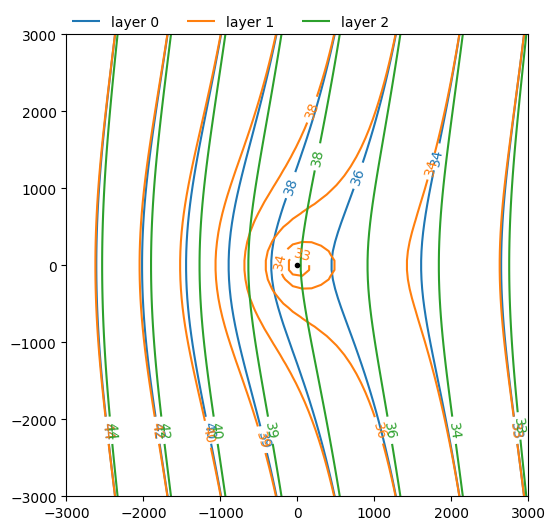
Create a contour plot of the head in the three aquifers. Use a window with lower left hand corner \((x,y)=(−3000,−3000)\) and upper right hand corner \((x,y)=(3000,3000)\). Notice that the heads in the three aquifers are almost equal at three times the largest leakage factor.
ml.plots.contour(
    win=[-3000, 3000, -3000, 3000],
    ngr=50,
    layers=[0, 1, 2],
    levels=10,
    legend=True,
    figsize=figsize,
);
Exercise 1d#
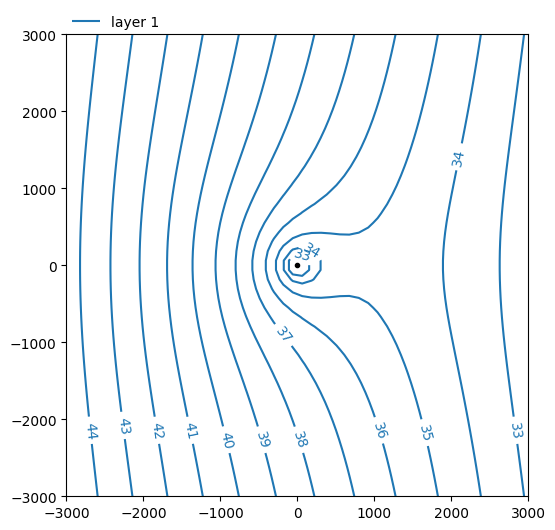
Create a contour plot of the head in aquifer 1 with labels along the contours. Labels are added when the labels keyword argument is set to True. The number of decimal places can be set with the decimals keyword argument, which is zero by default.
ml.plots.contour(
    win=[-3000, 3000, -3000, 3000],
    ngr=50,
    layers=[1],
    levels=np.arange(30, 45, 1),
    labels=True,
    legend=["layer 1"],
    figsize=figsize,
);
Exercise 1e#
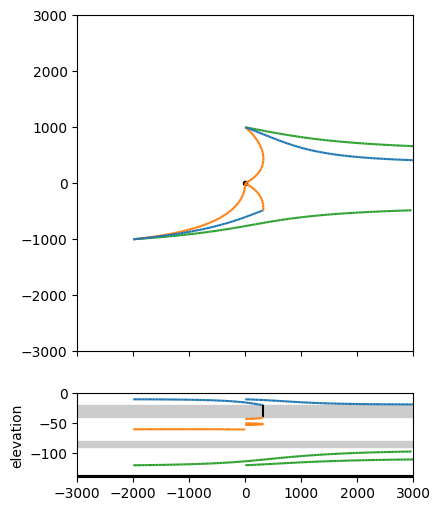
Create a contour plot with a vertical cross-section below it. Start three pathlines from \((x,y)=(-2000,-1000)\) at levels \(z=-120\), \(z=-60\), and \(z=-10\). Try a few other starting locations.
win = [-3000, 3000, -3000, 3000]
axes = ml.plots.topview_and_xsection(win=win, figsize=figsize)
ml.plots.tracelines(
    -2000 * np.ones(3),
    -1000 * np.ones(3),
    [-120, -60, -10],
    hstepmax=50,
    win=win,
    orientation="both",
    ax=axes,
)
ml.plots.tracelines(
    0 * np.ones(3),
    1000 * np.ones(3),
    [-120, -50, -10],
    hstepmax=50,
    win=win,
    orientation="both",
    ax=axes,
)
.
.
.

.
.
.
array([<Axes: >, <Axes: ylabel='elevation'>], dtype=object)
Exercise 1f#
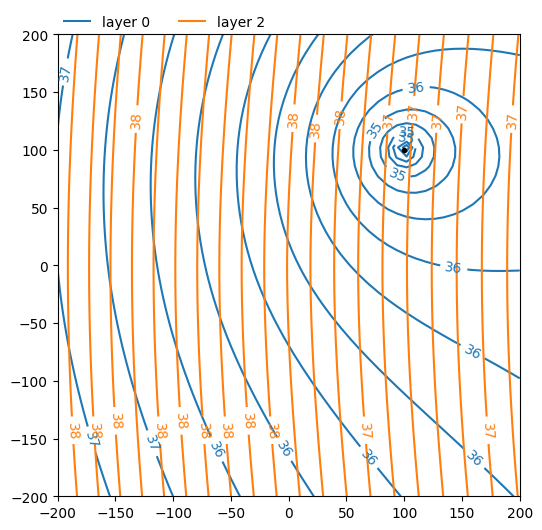
Add an abandoned well that is screened in both aquifer 0 and aquifer 1, located at \((x, y) = (100, 100)\) and create contour plot of all aquifers near the well (from (-200,-200) till (200,200)). What are the discharge and the head at the abandoned well? Note that you have to solve the model again!
ml = tfs.ModelMaq(kaq=[10, 20, 5], z=[0, -20, -40, -80, -90, -140], c=[4000, 10000])
w = tfs.Well(ml, xw=0, yw=0, Qw=10000, rw=0.2, layers=1)
tfs.Constant(ml, xr=10000, yr=0, hr=20, layer=0)
tfs.Uflow(ml, slope=0.002, angle=0)
wabandoned = tfs.Well(ml, xw=100, yw=100, Qw=0, rw=0.2, layers=[0, 1])
ml.solve()
ml.plots.contour(
    win=[-200, 200, -200, 200],
    ngr=50,
    layers=[0, 2],
    levels=20,
    color=["C0", "C1", "C2"],
    legend=True,
    figsize=figsize,
);
Number of elements, Number of equations: 4 , 3
.
.
.
.

solution complete
print("The head at the abandoned well is:")
print(wabandoned.headinside())
print("The discharge at the abandoned well is:")
print(wabandoned.discharge())
The head at the abandoned well is:
[33.62101294 33.62101294]
The discharge at the abandoned well is:
[ 431.40914098 -431.40914098    0.        ]