Well near a straight river#
import matplotlib.pyplot as plt
import numpy as np

import timflow.transient as tft

plt.rcParams["font.size"] = 8.0
Consider a well in the middle aquifer of a three aquifer system located at \((x,y)=(0,0)\). The well starts pumping at time \(t=0\) at a discharge of \(Q=1000\) m\(^3\)/d. Aquifer properties are the shown in table 3 (same as exercise 2). A stream runs North-South along the line \(x=50\). The head along the stream is fixed.
Table 3 - Aquifer properties for exercise 3.
Layer |
\(k\) (m/d) |
\(c\) (d) |
\(S\) |
\(S_s\) |
\(z_t\) (m) |
\(z_b\) (m) |
|---|---|---|---|---|---|---|
Aquifer 0 |
1 |
0.1 |
25 |
20 |
||
Leaky layer 1 |
1000 |
0 |
20 |
18 |
||
Aquifer 1 |
20 |
0.0001 |
18 |
10 |
||
Leaky layer 2 |
2000 |
0 |
10 |
8 |
||
Aquifer 2 |
2 |
0.0001 |
8 |
0 |
Exercise 3a#
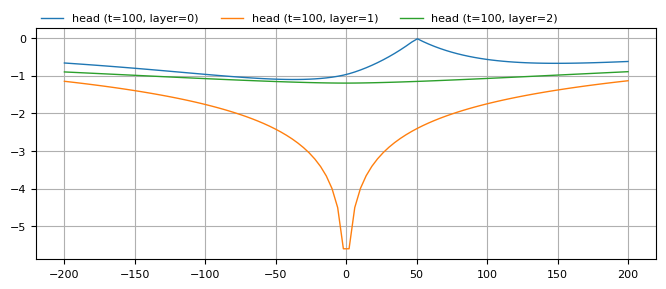
Model a 1000 m long section of the stream using 12 linesinks with \(y\)-endpoints at [-500,-300,-200,-100,-50,0,50,100,200,300,500]. Create a cross-section of the head along \(y=0\) from \(x=-200\) to \(x=200\) in all 3 layers.
ml = tft.ModelMaq(
    kaq=[1, 20, 2],
    z=[25, 20, 18, 10, 8, 0],
    c=[1000, 2000],
    Saq=[0.1, 1e-4, 1e-4],
    Sll=[0, 0],
    phreatictop=True,
    tmin=0.1,
    tmax=1000,
)
w = tft.Well(ml, xw=0, yw=0, rw=0.2, tsandQ=[(0, 1000)], layers=1, label="well 1")
yls = [-500, -300, -200, -100, -50, 0, 50, 100, 200, 300, 500]
xls = 50 * np.ones(len(yls))
ls1 = tft.RiverString(
    ml, list(zip(xls, yls, strict=False)), tsandh="fixed", layers=0, label="river"
)
ml.solve()
ml.plots.head_along_line(
    x1=-200, x2=200, npoints=100, t=100, layers=[0, 1, 2], sstart=-200, figsize=(8, 3)
);
self.neq  11
solution complete
Exercise 3b#
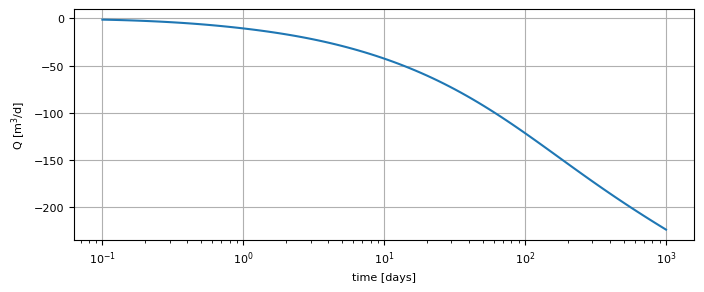
Compute the discharge of the stream section (the stream depletion) as a function of time from \(t=0.1\) till \(t=1000\) days.
t = np.logspace(-1, 3, 100)
Q = ls1.discharge(t)
plt.figure(figsize=(8, 3))
plt.semilogx(t, Q[0])
plt.ylabel("Q [m$^3$/d]")
plt.xlabel("time [days]")
plt.grid()
Exercise 3c#
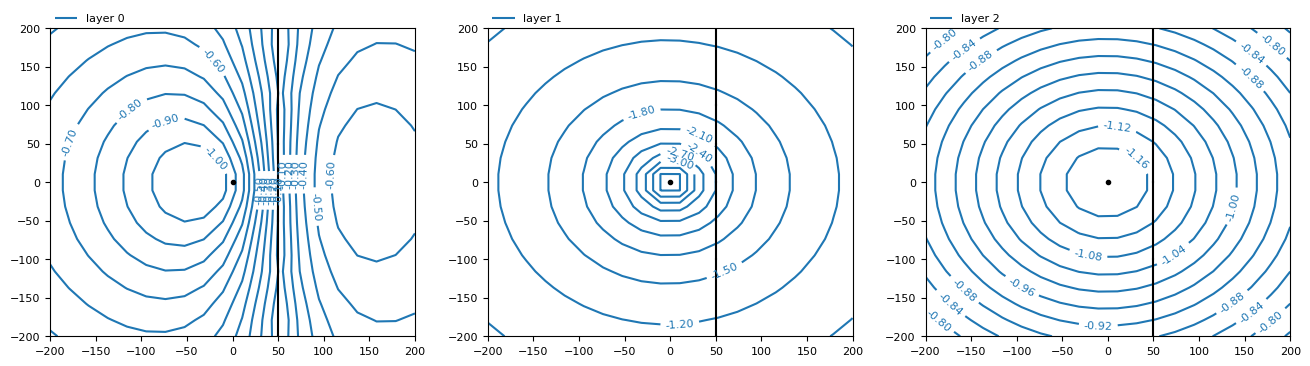
Make a contour plot of each layer after 100 days of pumping. Use 20 grid points in each direction (this may take a little time).
plt.figure(figsize=(16, 4))
for ilay in [0, 1, 2]:
    ax = plt.subplot(1, 3, ilay + 1)
    ml.plots.contour(
        win=[-200, 200, -200, 200],
        ngr=[20, 20],
        t=100,
        layers=ilay,
        levels=10,
        color="C0",
        labels=True,
        decimals=2,
        ax=ax,
    )
Exercise 3d#
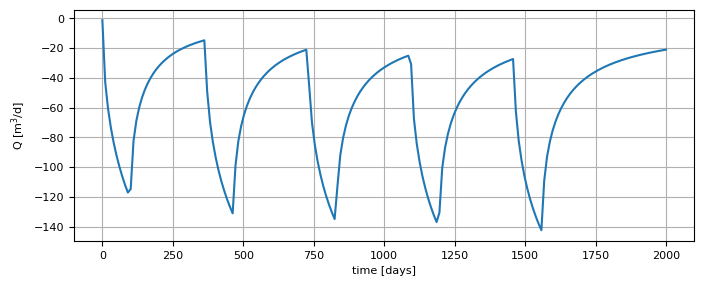
The discharge of the well is \(Q=1000\) m\(^3\)/d for 100 days every summer. Compute the stream depletion for a five year period.
ml = tft.ModelMaq(
    kaq=[1, 20, 2],
    z=[25, 20, 18, 10, 8, 0],
    c=[1000, 2000],
    Saq=[0.1, 1e-4, 1e-4],
    Sll=[0, 0],
    phreatictop=True,
    tmin=0.1,
    tmax=2000,
)
tsandQ = [
    (0, 1000),
    (100, 0),
    (365, 1000),
    (465, 0),
    (730, 1000),
    (830, 0),
    (1095, 1000),
    (1195, 0),
    (1460, 1000),
    (1560, 0),
]
w = tft.Well(ml, xw=0, yw=0, rw=0.2, tsandQ=tsandQ, layers=1, label="well 1")
yls = [-500, -300, -200, -100, -50, 0, 50, 100, 200, 300, 500]
xls = 50 * np.ones(len(yls))
ls1 = tft.RiverString(
    ml, list(zip(xls, yls, strict=False)), tsandh="fixed", layers=0, label="river"
)
ml.solve()

t = np.linspace(0.1, 2000, 200)
Q = ls1.discharge(t)
plt.figure(figsize=(8, 3))
plt.plot(t, Q[0])
plt.ylabel("Q [m$^3$/d]")
plt.xlabel("time [days]")
plt.grid()
self.neq  11
solution complete