
2. Slug Test - Falling Head#
Import packages#
import matplotlib.pyplot as plt
import numpy as np
import pandas as pd

import timflow.transient as tft

plt.rcParams["figure.figsize"] = [5, 3]
Introduction and Conceptual Model#
This slug test, taken from the AQTESOLV examples (Duffield, 2007), was reported in Batu (1998).
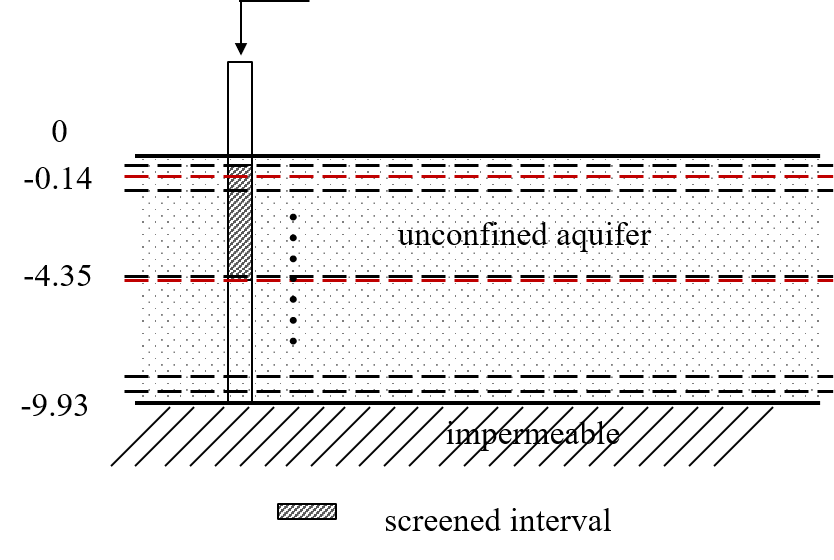
A well partially penetrates a sandy unconfined aquifer that has a saturated depth of 32.57 ft. The top of the screen is located 0.47 ft below the water table and has 13.8 ft in length. The well and casing radii are 5 and 2 inches, respectively. The slug displacement is 1.48 ft. Head change has been recorded at the slug well.
Load data#
data = np.loadtxt("data/falling_head.txt", skiprows=2)
to = data[:, 0] / 60 / 60 / 24  # convert time from seconds to days
ho = (10 - data[:, 1]) * 0.3048  # convert drawdown from ft to meters
Parameters and model#
rw = 5 * 0.0254  # well radius in m (5 inch = 0.127 m)
rc = 2 * 0.0254  # well casing radius in m (2 inch = 0.0508 m)
L = 13.8 * 0.3048  # screen length in m (13.8 ft = 4.2 m)
b = -32.57 * 0.3048  # aquifer thickness in m (-32.57 ft = -9.92 m)
zt = -0.47 * 0.3048  # depth to top of the screen in m (-0.47 ft = -0.14 m)
H0 = 1.48 * 0.3048  # initial displacement in the well in m (1.48 ft = 0.4511 m)
zb = zt - L  # bottom of the screen in m
convert measured displacement into volume
Q = np.pi * rc**2 * H0
print(f"slug: {Q:.5f} m^3")
slug: 0.00366 m^3
We will create a multi-layer model. For this, we divide the second and third layers into 0.5 m thick layers.
# The thickness of each layer is set to be 0.5 m
z0 = np.arange(zt, zb, -0.5)
z1 = np.arange(zb, b, -0.5)
zlay = np.append(z0, z1)
zlay = np.append(zlay, b)
zlay = np.insert(zlay, 0, 0)
nlay = len(zlay) - 1  # number of layers
Saq = 1e-4 * np.ones(nlay)
Saq[0] = 0.1
ml = tft.Model3D(
    kaq=10, z=zlay, Saq=Saq, kzoverkh=1, tmin=1e-5, tmax=0.01, phreatictop=True
)
w = tft.Well(
    ml,
    xw=0,
    yw=0,
    rw=rw,
    tsandQ=[(0, -Q)],
    layers=[1, 2, 3, 4, 5, 6, 7, 8],
    rc=rc,
    wbstype="slug",
)
ml.solve()
self.neq  8
solution complete
Estimate aquifer parameters#
cal = tft.Calibrate(ml)
cal.set_parameter(name="kaq", layers=list(range(nlay)), initial=10, pmin=0)
cal.set_parameter(name="Saq", layers=list(range(nlay)), initial=1e-4, pmin=0)
cal.seriesinwell(name="obs", element=w, t=to, h=ho)
cal.fit(report=True)
.......
........
........
........
.
Fit succeeded.
[[Fit Statistics]]
    # fitting method   = leastsq
    # function evals   = 29
    # data points      = 27
    # variables        = 2
    chi-square         = 0.00108531
    reduced chi-square = 4.3413e-05
    Akaike info crit   = -269.286523
    Bayesian info crit = -266.694850
[[Variables]]
    kaq_0_21:  0.49529205 +/- 0.02255769 (4.55%) (init = 10)
    Saq_0_21:  4.0631e-04 +/- 1.0398e-04 (25.59%) (init = 0.0001)
[[Correlations]] (unreported correlations are < 0.100)
    C(kaq_0_21, Saq_0_21) = -0.9593
display(cal.parameters)
print("RMSE:", cal.rmse())
| layers | optimal | std | perc_std | pmin | pmax | initial | inhoms | parray | |
|---|---|---|---|---|---|---|---|---|---|
| kaq_0_21 | [0, 1, 2, 3, 4, 5, 6, 7, 8, 9, 10, 11, 12, 13,... | 0.495292 | 0.022558 | 4.554423 | 0.0 | inf | 10.0000 | None | [[0.49529205203295823, 0.49529205203295823, 0.... |
| Saq_0_21 | [0, 1, 2, 3, 4, 5, 6, 7, 8, 9, 10, 11, 12, 13,... | 0.000406 | 0.000104 | 25.591996 | 0.0 | inf | 0.0001 | None | [[0.00040631090961307237, 0.000406310909613072... |
RMSE: 0.006340094887655789
tm = np.logspace(np.log10(to[0]), np.log10(to[-1]), 100)
hm = w.headinside(tm)
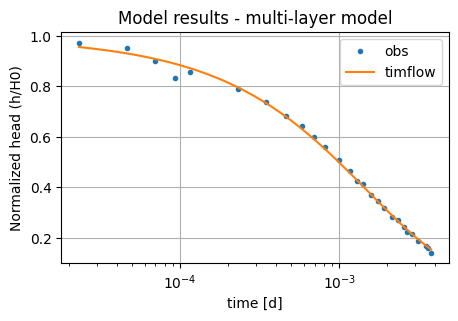
plt.semilogx(to, ho / H0, ".", label="obs")
plt.semilogx(tm, hm[0] / H0, label="timflow")
plt.xlabel("time [d]")
plt.ylabel("Normalized head (h/H0)")
plt.title("Model results - multi-layer model")
plt.legend()
plt.grid()
Comparison of results#
Here, we reproduce the work of Yang (2020) to check the timflow performance in analysing slug tests. We compare the solution in timflow with the KGS analytical model (Hyder et al. 1994) implemented in AQTESOLV (Duffield, 2007). AQTESOLV parameters are quite different from the set parameters in timflow. Furthermore, AQTESOLV also has a better RMSE performance.
t = pd.DataFrame(
    columns=["k [m/d]", "Ss [1/m]", "RMSE [m]"],
    index=["timflow-multi", "AQTESOLV"],
)

t.loc["timflow-multi"] = np.append(cal.parameters["optimal"].values, cal.rmse())
t.loc["AQTESOLV"] = [2.616, 7.894e-5, 0.001197]

t_formatted = t.style.format(
    {"k [m/d]": "{:.2f}", "Ss [1/m]": "{:.2e}", "RMSE [m]": "{:.3f}"}
)
t_formatted
| k [m/d] | Ss [1/m] | RMSE [m] | |
|---|---|---|---|
| timflow-multi | 0.50 | 4.06e-04 | 0.006 |
| AQTESOLV | 2.62 | 7.89e-05 | 0.001 |
References#
Batu, V. (1998), Aquifer hydraulics: a comprehensive guide to hydrogeologic data analysis, John Wiley & Sons
Duffield, G.M. (2007), AQTESOLV for Windows Version 4.5 User’s Guide, HydroSOLVE, Inc., Reston, VA.
Hyder, Z., Butler Jr, J.J., McElwee, C.D. and Liu, W. (1994), Slug tests in partially penetrating wells, Water Resources Research 30, 2945–2957.